Monday, March 3, 2014

Walking and Your Feet

About 67 million adults in this country have discovered that walking is one of the most fun, natural, and inexpensive ways of keeping your health—and your feet—in top shape. Walking can be enjoyed almost anywhere, anytime, and year around. It's also a good way to get exercise, particularly for people who are out-of-shape.

According to the American Podiatric Medical Association, exercise offers a host of benefits. Walking helps control weight, blood sugar, and cholesterol levels. A brisk walk can burn up to 100 calories per mile or 300 calories per hour. Walking also improves cardiovascular fitness. As an aerobic exercise, walking gets the heart beating faster to transport oxygen-rich blood from the lungs to the muscles. The heart and lungs grow more efficient with a regular walking regimen, reducing blood pressure and the resting heart rate. Walking is also a central element of medical rehabilitation for a wide array of health problems. For example, recovery from a heart attack can be facilitated by a regular walking regimen. Additionally, walking creates an overall feeling of well-being, and can relieve depression, anxiety, and stress by producing endorphins, the body's natural tranquilizer. A brisk walk will relax you and also stimulate your thinking.

To gain the most health benefit from walking, it is important to pay attention to your feet. Shoes that don't fit properly or provide adequate support, lack of stretching, and improper gait can lead to foot injuries or pain. The most common foot problems are blisters, corns, calluses, and plantar fasciitis.

Walking Shoes

The only equipment you need to enjoy walking for fitness is a good pair of shoes. But before you can shop for the best shoe for your foot, you need to identify the natural inclination of your foot and gait. There are three basic foot types:
  • Pronators are people with relatively flat feet, caused by low arches, which generally leads to overpronation, or a gait in which the ankle rolls inward excessively. People with this foot type need motion control shoes that offer support for mid-foot. Motion-control shoes are more rigid and built on a straight last. These are generally board-lasted shoes, which have a piece of cardboard running the length of the shoe for greater stability. Look for sturdy uppers for added stability and avoid shoes with a lot of cushioning or highly curved toes. Also look for a reinforced heel counter to maintain foot support and stability.
  • Supinators are people with high arches, which can lead to underpronation that places too much weight on the outsides of the feet. People with this foot type need stability shoes designed for extra shock absorption and often having a curved or semi-curved last. A slip-lasted shoe is also recommended, because the sewn seam runs the length of the shoe giving it greater flexibility. Also look for shoes that are reinforced around the ankle and heel to stabilize the foot and extra cushioning under the ball of the foot.
  • People with normal feet can wear any type of walking shoe, although a curved last is generally preferred.
When you walk, the natural motion of your foot rolls gradually from the heel to the toe, with your foot bending at the ball on each step. That's why it is important for walking shoes to have enough flexibility in just the right places. A good walking shoe should give a little when you twist it and bend at the ball of the foot. When you put the shoe on a flat surface and push on the toe the heel should come up off the surface. If it does, the shoe has the curvature you need to conform to your movement during walking. Make sure the heel is low and not too wide. A slight undercut in the heel will help your foot begin its roll from the heel through the step.
Here are some other important tips for buying a good pair of walking shoes:
  • Shop at the end of the day when your feet are slightly swollen to get a good fit.
  • Try on shoes with the socks you will wear when walking. If you use an orthotic, bring that to the store when you try on shoes as well.
  • Have your feet measured standing up and fit your shoes to the larger of your two feet.
  • Be sure there is enough room in the toe box for your toes to wiggle and about a half inch between your toes and the end of the shoe.
  • Take time when shopping to try on different brands and walk around the store in each pair. Be sure to walk on a hard surface, not just on carpeting. Let your foot be the guide to the fit, not the shoe size or style.
  • Look for lightweight, breathable materials for greater comfort.
  • Run your hand all over and inside the shoes to feel for any seams or catches that might irritate your foot.
  • Choose shoes that lace for better foot stability and control.
  • Make sure your heel fits snugly and does not tend toward slipping out of the shoe.
  • Wear your walking shoes only for walking to extend their life. Consider buying two pairs and rotating your wear to give each pair time to breath between walks.
  • Replace walking shoes after every 300 to 600 miles, depending on how hard you are on your shoes.
Please contact us if you have any questions regarding your feet or how we may help keep you walking in comfort at 704-786-4482 or visit our website at http://www.familyfootcare.info/.

Monday, February 24, 2014

Nail Fungus

Many people don't realize they have a fungal nail problem and, therefore, don't seek treatment. Yet, fungal toenail infections are a common foot health problem and can persist for years without ever causing pain. The disease, characterized by a change in a toenail's color, is often considered nothing more than a mere blemish. Left untreated, however, it can present serious problems.
Also referred to as onychomycosis, fungal nails are infections underneath the surface of the nail, which may also penetrate the nail. Fungal nail infections are often accompanied by a secondary bacterial and/or yeast infection in or about the nail plate, which ultimately can lead to difficulty and pain when walking or running. Symptoms may include discoloration, brittleness, loosening, thickening, or crumbling of the nail.
A group of fungi, called dermophytes, easily attack the nail and thrive on keratin, the nail's protein substance. In some cases, when these tiny organisms take hold, the nail may become thicker, yellowish-brown, or darker in color, and foul smelling. Debris may collect beneath the nail plate, white marks may frequently appear on the nail plate, and the infection is capable of spreading to other toenails, the skin, or even the fingernails.

Nail bed injury may make the nail more susceptible to all types of infection, including fungal infection. Those who suffer chronic diseases, such as diabetes, circulatory problems, or immune-deficiency conditions, are especially prone to fungal nails. Other contributory factors may be a history of Athlete's Foot or excessive perspiration.
You can prevent fungal nail infections by taking these simple precautions:
  • Exercise proper hygiene and regularly inspect your feet and toes.
  • Keep your feet clean and dry.
  • Wear shower shoes in public facilities whenever possible.
  • Clip nails straight across so that the nail does not extend beyond the tip of the toe.
  • Use a quality foot powder (talcum, not cornstarch) in conjunction with shoes that fit well and are made of materials that breathe.
  • Avoid wearing excessively tight hosiery, which promotes moisture. Socks made of synthetic fiber tend to "wick" away moisture faster than cotton or wool socks, especially for those with more active lifestyles.
  • Disinfect home pedicure tools and don't apply polish to nails suspected of infection.
Depending on the type of infection you have, over-the-counter liquid antifungal agents may not prevent a fungal infection from recurring. A topical or oral medication may need to be prescribed, and the diseased nail matter and debris removed, a process called debridement. Note: Please consult your physician before taking any medications.

In severe cases, surgical treatment may be required to remove the infected nail. Permanent removal of a chronically painful nail, which has not responded to any other treatment, permits the fungal infection to be cured and prevents the return of a deformed nail.
If your nail requires professional care call FAMILY FOOT CARE at 704-786-4482 or visit our website at http://www.familyfootcare.info/.

Wednesday, February 19, 2014

Heel Pain

Plantar fasciitis
Heel pain is a very common foot problem. Many people experience pain after being on their feet for a long period of time or with the first steps in the morning.
Some helpful tips are to not walk barefoot. Keep a pair of supportive shoes close by that you can slip on in the morning. Stretch your calf muscles daily. Increasing the flexibility of your calf muscles. Make sure your shoes are supportive, and not too flexible. You can also try over the counter orthotics for your shoes.
When stretching and shoe changes do not work, it may be time to see a professional for further care. At FAMILY FOOT CARE we can prescribe custom orthotics and provide further treatment modalities to help eliminate your pain. We have 3 locations to serve you. 704-786-4482. Visit us in Concord 1022 Lee Ann Drive; Harrisburg 6602 Roberta Road; Locust 209 Town Center Drive.

Tuesday, February 4, 2014

Ingrown toenails

Curved toenails?
Are you toenails so curved that they look like and upside down “u”? You may have chronic ingrown toenails.
Ingrown toenails can be genetic or caused by external factors such as the shoes you wear and how your toenails are trimmed.
Avoid digging down into the nail fold or cutting the edges of the nail. When you try to trim the toenail yourself you can cause the ingrown toenail to get worse, or even infected.
To prevent ingrown toenails, the nail should be trimmed straight across. Ensure that your shoes are fitting properly so they do not cause extra pressure on the toenail. If your ingrown toenail requires professional care call FAMILY FOOT CARE. We have 3 locations to serve you. 704-786-4482.

Visit us in Concord 1022 Lee Ann Drive; Harrisburg 6602 Roberta Road; Locust 209 Town Center Drive.

Tuesday, January 7, 2014

DIABETIC FOOT CARE

Diabetes is a serious disease that can result in devastating complications, if not properly managed. Diabetes affects every part of your body from head to toe. Daily foot care is very important to prevent sores and amputations. You should inspect your feet daily for sores or red areas from ill-fitting shoes. Check shoes for debris that could injure your foot. Cut and file toe nails straight across, taking care not to cut them too short. Your skin should be moisturized daily. Even well controlled diabetics with no complications need a thorough foot exam at least once a year.
Call INSTRIDE FAMILY FOOT CARE today to schedule your diabetic foot exam. We have two convenient locations to serve you.

1022 Lee Ann Drive Concord, NC 28025 (704)-786-4482

6602 Roberta Road Harrisburg, NC 28075 (704)-454-5558

Tuesday, December 10, 2013

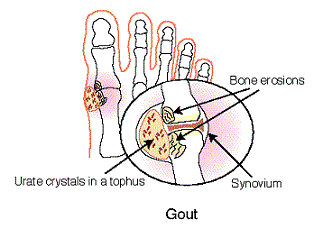
OUCH! GOUT!

Gout is characterized by sudden, severe attacks of pain, redness and tenderness in joints, often the big toe joint. Men are more likely to be affected by gout; however, anyone can be affected. The pain can be intense enough to wake you up in the middle of the night. Gout is caused by an increase in uric acid in your blood, which causes urate crystals to deposit in the joint. Your body produces uric acid when it breaks down purines — substances that are found naturally in your body, as well as in certain foods, such as organ meats, anchovies, herring, asparagus and mushrooms. Gout can be controlled with changing eating habits or oral medication. At FAMILYFOOT CARE we can help relieve your pain from a gout attack, and point you in the right direction to decrease these attacks. Call us to schedule your appointment today. We have three convenient locations to serve you.

1022 Lee Ann Drive Concord, NC 28025 704-786-4482

6602 Roberta Road Harrisburg, NC 28075 704-454-5558

209 Town Center Drive Locust, NC 28097 704-897-6081

Tuesday, November 19, 2013

BUNCHED UP SOCK?

Have you ever felt like your sock was bunched up in your shoe, but it wasn’t? That could be a symptom of a neuroma. Other symptoms of a neuroma may include burning pain or numbness in the ball of the foot. A neuroma is a thickening of the nerve tissue as a result of compression and irritation. Wearing shoes with a narrow toe box or high-heeled shoes can contribute to the formation of a neuroma. The symptoms may come and go, but usually get worse over time as the neuroma enlarges. Neuromas can be treated conservatively with padding, icing, or activity modifications. The best time to visit a podiatrist is when the symptoms first start. Often times the treatment is less invasive, if caught early enough.
At FAMILY FOOTCARE we can offer many different treatment modalities to help relieve your neuroma pain. Call us to schedule your appointment today. We have three convenient locations to serve you.

1022 Lee Ann Drive Concord, NC 28025 704-786-4482

6602 Roberta Road Harrisburg, NC 28075 704-454-5558

209 Town Center Drive Locust, NC 28097 704-897-6081